
Are Swansea Gardeners Selling Themselves Too Short? The £25-an-Hour Problem
While researching local gardening rates for Shear Power, we came across something interesting in the
In 2021, Swansea gardeners were advertising an average of £25 an hour. Five years later, that figure is just £26. Has gardening somehow escaped inflation, or have local gardeners forgotten to put their prices up?
Imagine going into a petrol station in 2021, filling your van with diesel and then returning five years later to discover the price had barely changed.
Lovely thought, isn't it?
Unfortunately, that's not what happened.
But something rather similar appears to have happened to gardening prices in Swansea.
While researching local gardening rates for Shear Power, we came across something interesting in the Wayback Machine
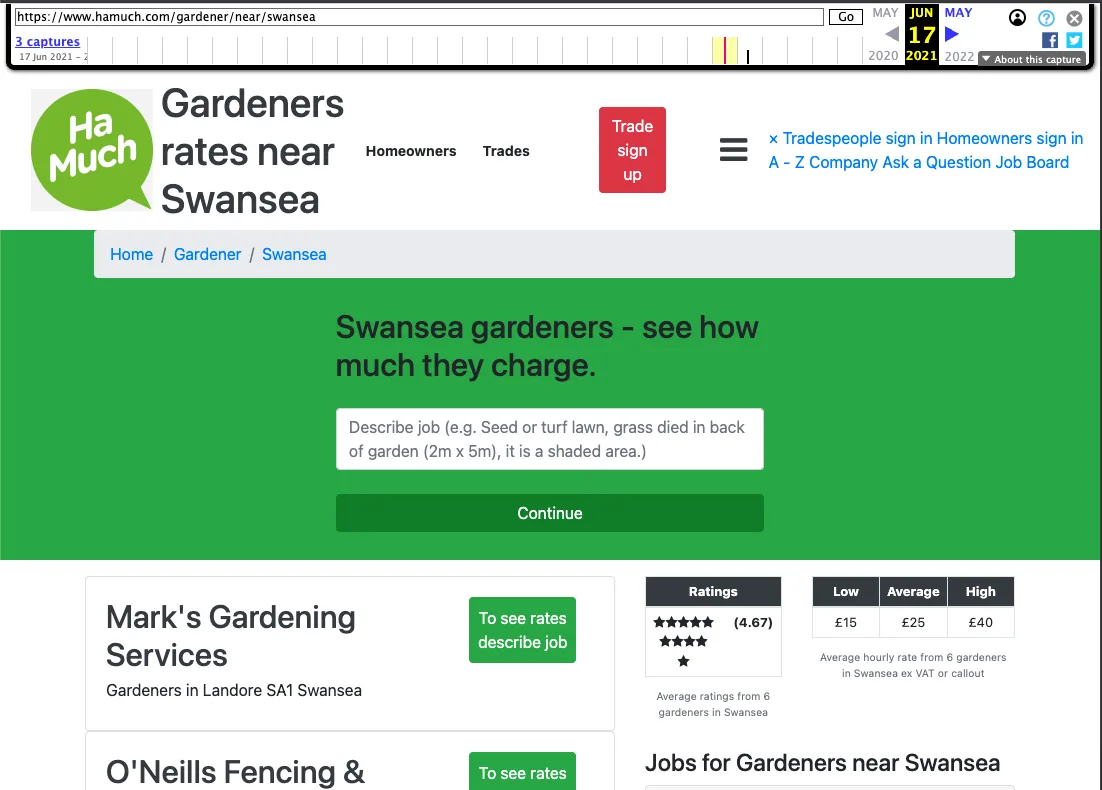
An archived HaMuch Swansea gardeners page from 17 June 2021 showed an average hourly rate of £25, based on six gardeners.
We then checked the same Swansea page in September 2026.
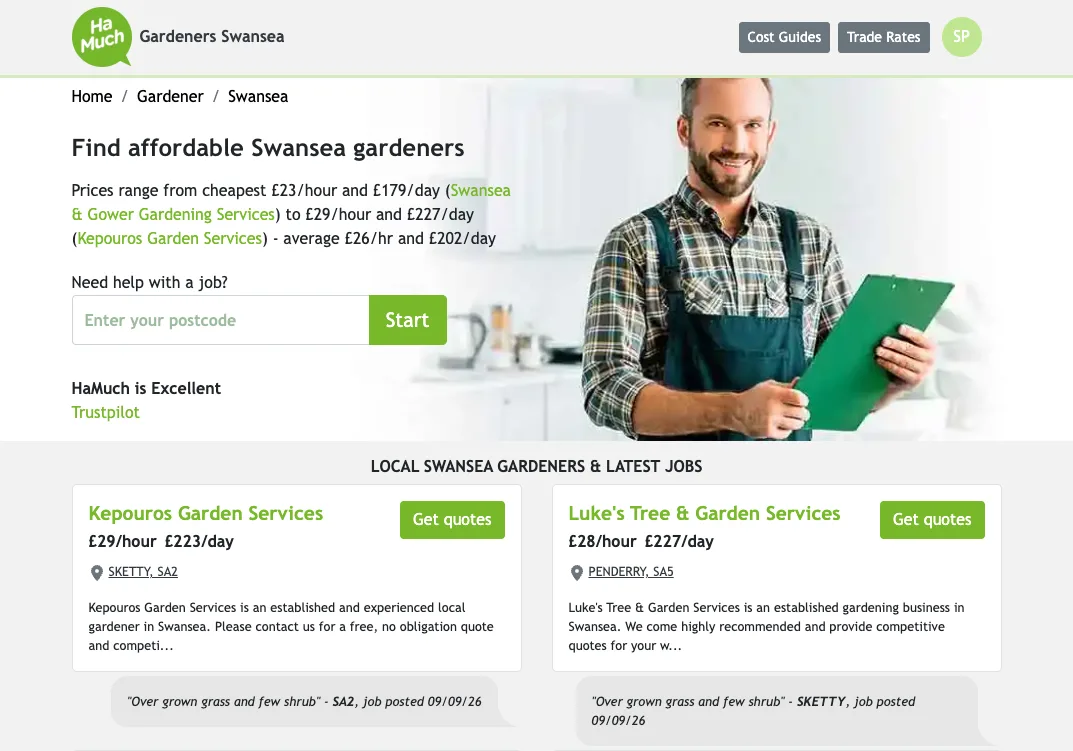
The advertised average?
£26 an hour.
Hamuch - Five years. One pound!
That raises a fairly obvious question.
What happened to the other £6 or so that inflation would suggest should have been added to the price?
The numbers: £25 in 2021 is worth approximately £32 today
Let's start with general inflation rather than guesswork.
According to the Office for National Statistics, the UK's Consumer Prices Index stood at 111.3 in June 2021 and 143.6 in August 2026, the latest available reading at the time of writing.
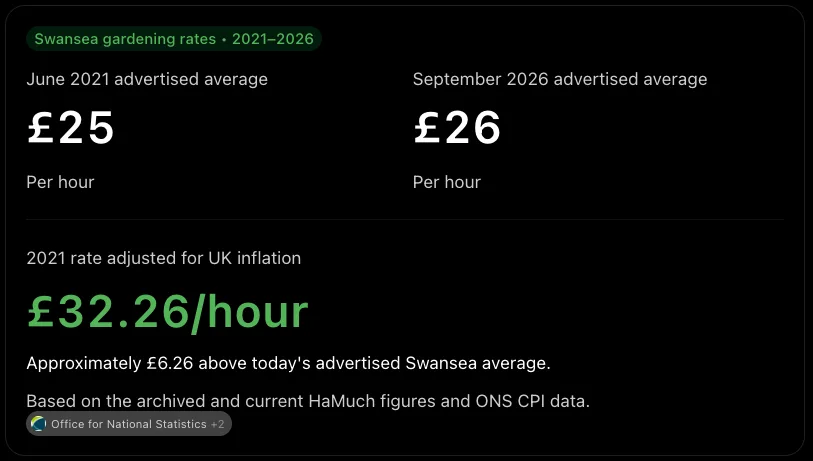
In other words, a gardener charging £26 today is receiving roughly the equivalent of £20.15 in June 2021 purchasing power.
That's about a 19% reduction in the real value of the advertised hourly rate.
There is an important qualification here: HaMuch's figures are advertised rates from businesses listed on its platform, not a comprehensive survey of every Swansea gardener or a record of what customers actually paid. The 2021 sample contained just six gardeners, and the businesses represented today may be different.
Nevertheless, comparing the same source across five years gives us a useful reason to investigate.
And the picture becomes more interesting when we look at the costs surrounding the job.
Diesel hasn't been sitting at £1.30 a litre
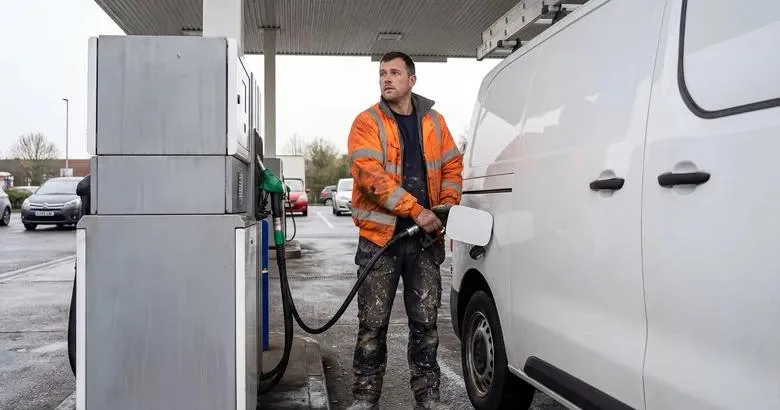
A gardener doesn't teleport from one lawn to the next.
There's a van to run, equipment to transport and often several journeys to make throughout the day.
The UK government's weekly fuel statistics put average diesel at 133.17p per litre on 14 June 2021.
By 14 September 2026, the UK average was 190.72p per litre.
That's an increase of approximately 43%.
And that lines up closely with what we've seen locally: diesel at Asda in Llansamlet has recently been around £1.92 per litre.
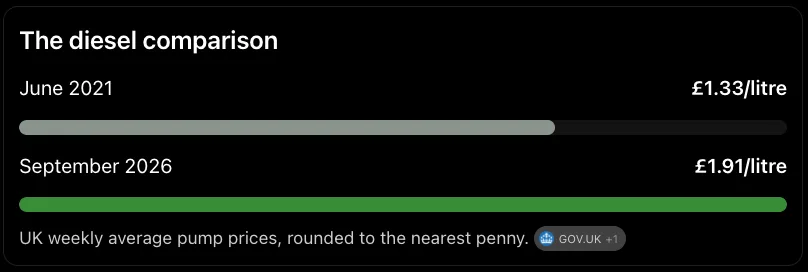
For a gardener using 40 litres of diesel a week, that difference amounts to approximately £23 more every week, or around £1,150 over 50 working weeks.
And that's just fuel.
It doesn't account for insurance, servicing, tyres, replacement machinery, repairs or the cost of disposing of green waste.
Not every cost has increased by the same percentage, and some businesses have reduced their fuel consumption by switching to battery-powered tools. But it's difficult to see how a £1 increase in the hourly charge could automatically compensate for everything.
Even the houses have become more expensive
Here's another interesting comparison.
According to HM Land Registry's UK House Price Index, the average Swansea property cost £169,168 in June 2021.
By July 2026, the average was £205,383.
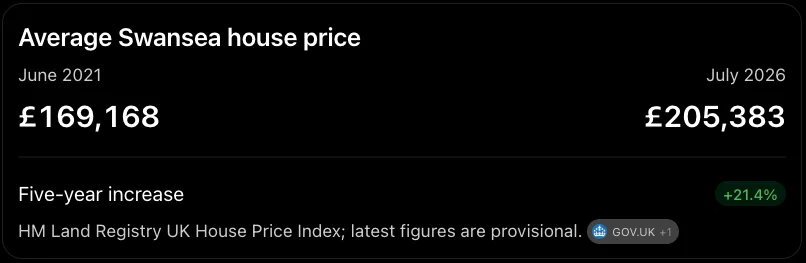
Now, rising house prices don't mean every homeowner has an extra £36,000 in their bank account. Recent buyers may actually be struggling with mortgage payments, and some homeowners are on fixed incomes.
But property prices provide useful context.
The value of the asset being maintained has risen substantially, while the advertised price of maintaining its garden has barely changed.
There's also the gardener's own position to consider. If they hope to buy a home, move house or simply maintain the same standard of living, a business charging almost the same rate as five years ago may be making those goals harder to achieve.
Have gardeners fallen into the pricing trap?
Here's a theory.
Someone decides to start a gardening business.
They buy a mower, a strimmer and perhaps an old van.
Then comes the awkward question.
What on earth should I charge?
Rather than calculate the cost of running the business, they search Google.
They find a gardening website advertising £25 an hour.
Then another.
Then a directory showing the local average.
So they decide £25 sounds about right.
Fair enough. Nobody wants to start their business by charging twice as much as everyone else.
But here's the problem.
What happens if the prices they're copying are three or four years out of date?
The new gardener publishes £25 on their own website.
Another new gardener sees that price and copies it.
Then another.
Before long, the market appears to have established that £25 is the correct price—not because anybody has worked out whether it's profitable, but because everybody keeps looking at everybody else.
The original price becomes an anchor.
And every time another business copies it, the anchor becomes harder to move.
Economists call the tendency to rely heavily on an initial piece of information anchoring. Social proof and fear of losing customers can reinforce it.
We haven't established that this is what caused Swansea's apparent pricing stagnation. To prove that, we'd need to interview gardeners, examine their pricing histories and establish what they actually charge.
Other explanations are possible: competition, customer budgets, longstanding client arrangements, outdated online listings or gardeners charging fixed job prices that work out higher than their published hourly rates.
But it's a question worth asking:
When was the last time you calculated what your hourly rate actually needs to be, rather than simply checking what everyone else charges?
What about plumbers and electricians? Are gardeners falling behind?
Perhaps £26 an hour is simply what Swansea customers are prepared to pay for a tradesperson.
Perhaps nobody has been putting their prices up.
Well, we've been digging around the Wayback Machine again, and the results suggest otherwise.
We found archived 2021 prices for Swansea plumbers and electricians on the same HaMuch website, then compared them with the advertised averages in September 2026.
Here's what we discovered.
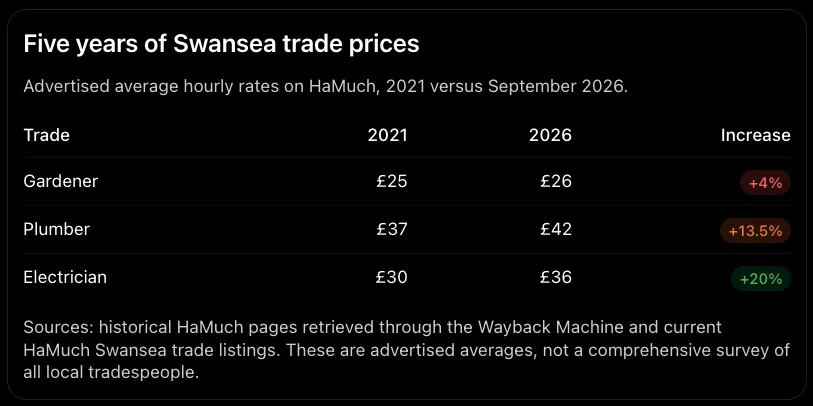
Now that's interesting.
Electricians have increased their advertised rates by £6 an hour.
Plumbers have increased theirs by £5.
Gardeners? One quid.
To put that into perspective, an electrician who charged £30 in 2021 and increased their price to £36 is now charging 20% more.
A gardener who charged £25 and increased it to £26 is charging just 4% more.
Gardeners haven't simply failed to keep pace with inflation. Based on these listings, they've also increased their prices much more slowly than two other Swansea trades.
Of course, there's an important distinction here. Plumbing and electrical work can involve different qualifications, regulatory requirements, equipment and responsibilities. We're not suggesting that a gardener should automatically charge the same as a plumber.
Nor do these directory snapshots prove that the same individual businesses increased their prices by these amounts. Businesses may have joined or left the listings between 2021 and 2026.
But they do tell us something useful.
Other local trades haven't all been standing still.
So why does gardening appear to be different?
Even plumbers and electricians haven't fully kept pace with inflation
There's another twist.
Remember that general UK consumer prices have risen by approximately 29% since June 2021.
If we apply that increase to each trade's 2021 rate, we get the following comparison.
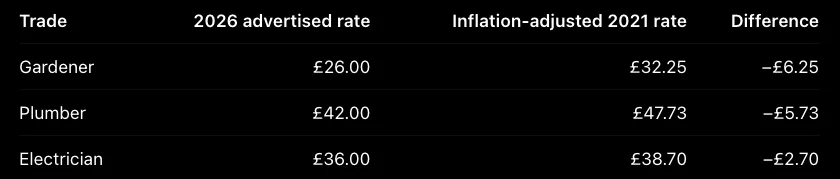
These inflation-adjusted figures are benchmarks, not recommended prices. They show what each 2021 hourly rate would need to become to retain approximately the same purchasing power.
And the result is revealing.
Even electricians, who have increased their rates by 20%, haven't quite kept up with general inflation.
Plumbers have fallen further behind.
But gardeners have experienced the largest proportional shortfall of the three.
At £26 an hour, Swansea's advertised gardening rate is approximately 19% below its inflation-adjusted 2021 equivalent in real purchasing-power terms.
That's a substantial difference for somebody whose business depends on selling their own time.
The hourly rate isn't even the whole problem
Let's say you're charging £26 an hour.
You spend 45 minutes cutting somebody's lawn.
Excellent. That's £19.50.
Except you've also spent:
15 minutes driving there.
5 minutes unloading and setting up.
10 minutes loading up, clearing away and getting ready for the next job.
You've used 75 minutes of your working day to earn £19.50.
That's an effective £15.60 per working hour before fuel, machinery, insurance and every other business expense.
The numbers are illustrative, but the problem is real.
A gardener with six genuinely billable hours in an eight-hour day has a very different business from somebody who assumes every hour they leave the house is earning money.
That's why a successful gardening business needs more than an hourly rate.
It needs minimum charges, sensible travel areas, efficient scheduling and an understanding of the actual cost of each service.
A regular fortnightly lawn five minutes away may be highly profitable.
An identical lawn 35 minutes away might not be.
And an overgrown garden requiring several trips to dispose of waste is not the same job as a straightforward maintenance visit.
Should customers be paying more?
Possibly. But there's an important distinction between asking customers to pay more and asking gardeners to run more profitable businesses.
Nobody wants to discover that their regular lawn cut has suddenly increased by 30%.
Homeowners have experienced the same inflation as everyone else. Mortgage payments, groceries, energy bills and fuel have all put pressure on household budgets.
And rising house prices don't automatically mean homeowners have more disposable income.
But gardeners are dealing with those pressures too.
They need to earn enough to maintain their equipment, repair their vans, cover insurance, take holidays and put money aside for the quieter winter months.
A good gardener's price needs to work for both sides.
Customers deserve clear pricing, dependable service and a proper job. Gardeners deserve a business that pays them a reasonable living after expenses.
That doesn't necessarily mean adding 29% to every invoice tomorrow.
It means working out what each job actually costs to deliver and deciding whether the current price still makes sense.
For some gardeners, increasing prices may be necessary.
For others, improving their routes, reducing administration, encouraging regular bookings and eliminating expensive lead purchases could be just as important.
The two approaches aren't mutually exclusive.
What would £32 an hour actually mean?
Consider a gardener currently charging £26 for six billable hours per day.
That produces £156 in daily revenue.
At the inflation-adjusted rate of approximately £32.25, those same six billable hours would produce £193.50.
That's an additional £37.50 a day.
Over 200 working days, the difference is:
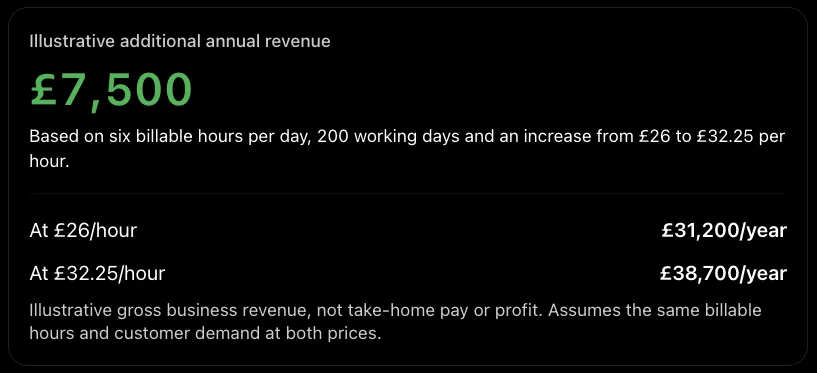
Of course, that's not £7,500 straight into the gardener's pocket.
There are business expenses to pay, and higher prices could affect demand.
But it puts the scale of the issue into perspective.
We're not talking about a gardener buying a yacht.
We're talking about whether the business can afford to replace a worn-out mower, absorb an unexpected van repair or provide its owner with a reasonable income.
And there's another way of looking at this.
If a gardener can eliminate an hour of unproductive driving and administration every day, they may be able to complete another paid job without extending their working hours.
Improving the efficiency of the business and charging sustainable prices could therefore make a considerable difference together.
Stop copying prices. Start understanding your business.
Here's what I find most interesting about this research.
In 2021, Swansea gardeners were advertising an average of £25 an hour.
By 2026, electricians had increased their advertised rates by 20%, plumbers by around 14%, and gardeners by just 4%.
We don't know exactly why.
It could be price competition, outdated online listings, customers resisting increases or gardeners keeping longstanding customers on their original rates.
It could also be the pricing trap we discussed earlier: new gardeners look at what existing gardeners charge, copy their prices and inadvertently reinforce an old market benchmark.
Whatever the explanation, the important question isn't whether £26 is the average. It's whether £26 is enough for your particular business.
Your costs might be higher.
Your equipment might be better.
Your service might be more reliable.
Your customers might value the convenience of online booking and knowing exactly when you'll arrive.
Or perhaps you can deliver the same quality at a lower price because you've built a particularly efficient gardening round.
The point is to know why you're charging what you're charging.
At Shear Power, we're developing technology and business systems to help independent gardeners do exactly that: calculate prices, organise regular work, manage customers, take payments and reduce the time spent on administration.
Because the answer to rising costs isn't necessarily to work longer hours.
Sometimes it's to price properly.
Sometimes it's to work more efficiently.
And sometimes it's both.
The next time you're wondering whether to put your prices up, don't just look at what the bloke down the road charges.
Look at your own numbers.